
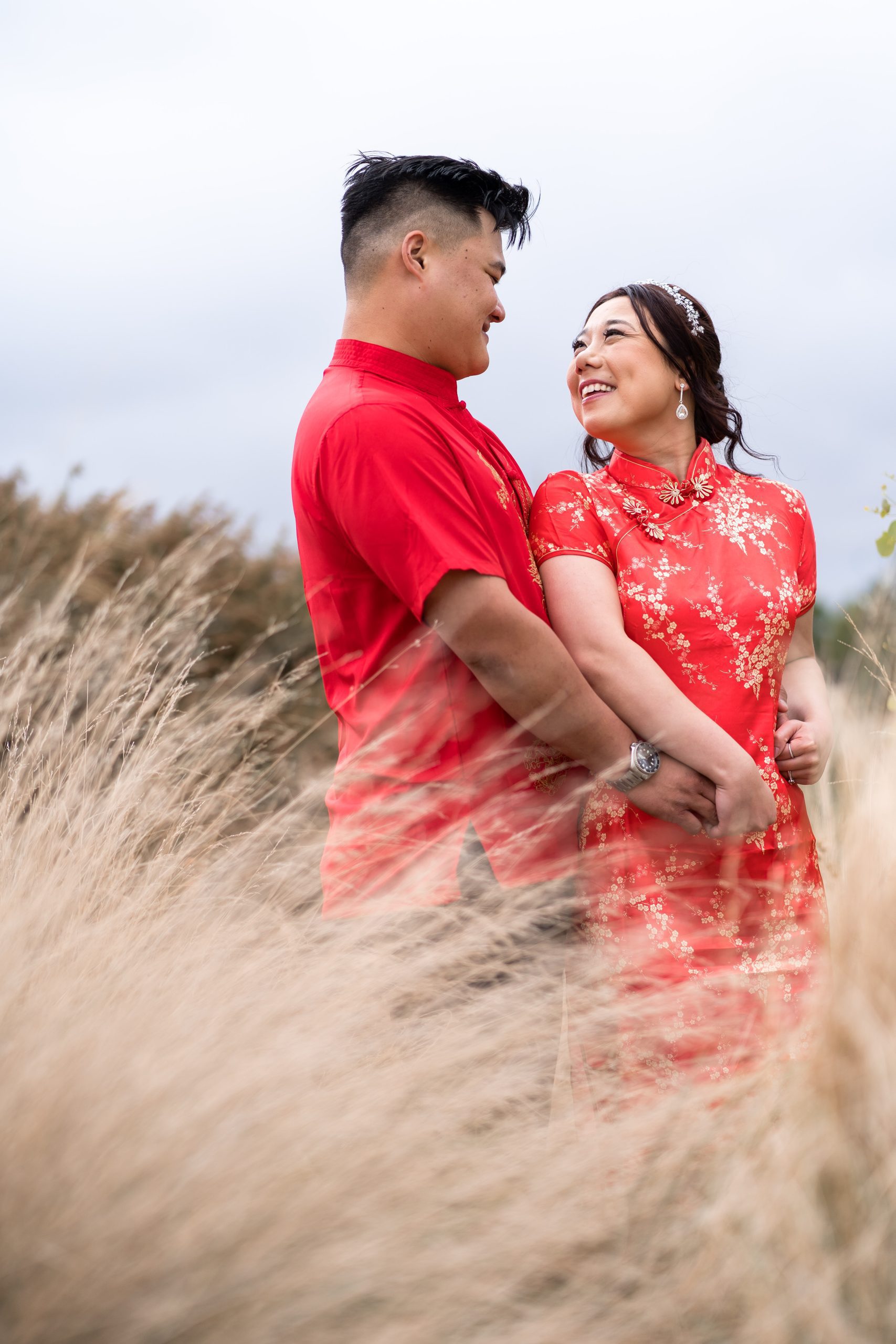
Tea ceremonies, gate games and banquets that run late — photographed by a team that knows how the day flows.
A Chinese wedding is rarely one event. There’s the hair combing the night before, the gate games at the bride’s door, the tea ceremony where two families become one, and a banquet that runs well into the night — often with two or three outfit changes along the way. Each moment has its own meaning, its own pace and its own light, and capturing it well means knowing what’s coming next before it happens. We photograph Chinese, Vietnamese and broader Asian weddings right across Melbourne, and this is what we’d tell any couple planning one.
The tea ceremony is the most meaningful part of the day. The couple serves tea to their elders in order of seniority and, in return, receives a blessing and a red envelope or a piece of gold. In a Chinese ceremony the couple usually kneels or bows, serving the groom’s family first and then the bride’s, with red envelopes (lai see), gold jewellery and symbolic sweets like lotus-seed buns. In a Vietnamese ceremony (Lễ Gia Tiên) the couple more often stands, both families are honoured together, and the groom’s party arrives bearing mâm quả — red lacquer trays of betel and areca, tea, fruit, cakes and a roast pig, carried in by unmarried members of the family.
It is also the hardest part of the day to photograph well. It happens early, usually in a family home or a hotel suite, in tight, mixed, low light with very little room to move. We position for it in advance — close enough to catch the small gestures without ever stepping into the moment — and we make sure every elder who is honoured is photographed with the couple.
“The tea ceremony is small, fast and full of meaning — we plan our angles before it starts so nothing is missed.”
Before the tea, there are the gate games — chuangmen in Chinese weddings, the bridesmaids’ challenge in Vietnamese ones. When the groom and his groomsmen arrive to collect the bride, her friends make him earn it: singing, dares, the four flavours (sour, sweet, bitter, spicy), questions about the bride, and red envelopes handed over before the door finally opens. It’s loud, funny and completely unscripted, and it sets the emotional tone for the whole morning.
This is candid photography at its most demanding — cramped hallways, people everywhere, laughter in quick bursts. We shoot it loose and reactive, chasing the reactions rather than posing them, so you get the genuine joy of it: the groom red-faced and laughing, the bridal party in charge, everyone in on the joke.
A photographer should know the rituals before the day, not learn them on it. We do, and we know they’re not all the same:
Whether your day leans traditional, modern or a blend of both — a dawn tea ceremony in a qipao or áo dài, a Western-style ceremony in a white gown, then a banquet — we’ve planned and photographed days like yours and we build the timeline so each part gets the coverage it deserves.
The Asian wedding banquet is its own production: the couple’s grand entrance (often more than one, with an outfit change), the toasting from table to table, the speeches, the cake, the games, and — for many couples — a lion dance in red and gold for double happiness. Reception venues built for these celebrations are large and dramatic. At banquet rooms like those at Crown, Gold Leaf, Ultima or the city’s Chinese restaurants and Vietnamese reception centres, the halls are big, dim and lit warm with tungsten and deep red-and-gold décor — beautiful to be in, unforgiving to photograph.
That’s where craft matters. We light these rooms properly — bounced and off-camera flash, gelled to match the warm ambient light, exposed so the colour, the food and the faces all read the way they looked on the night — instead of leaving you with dark, muddy reception photos.
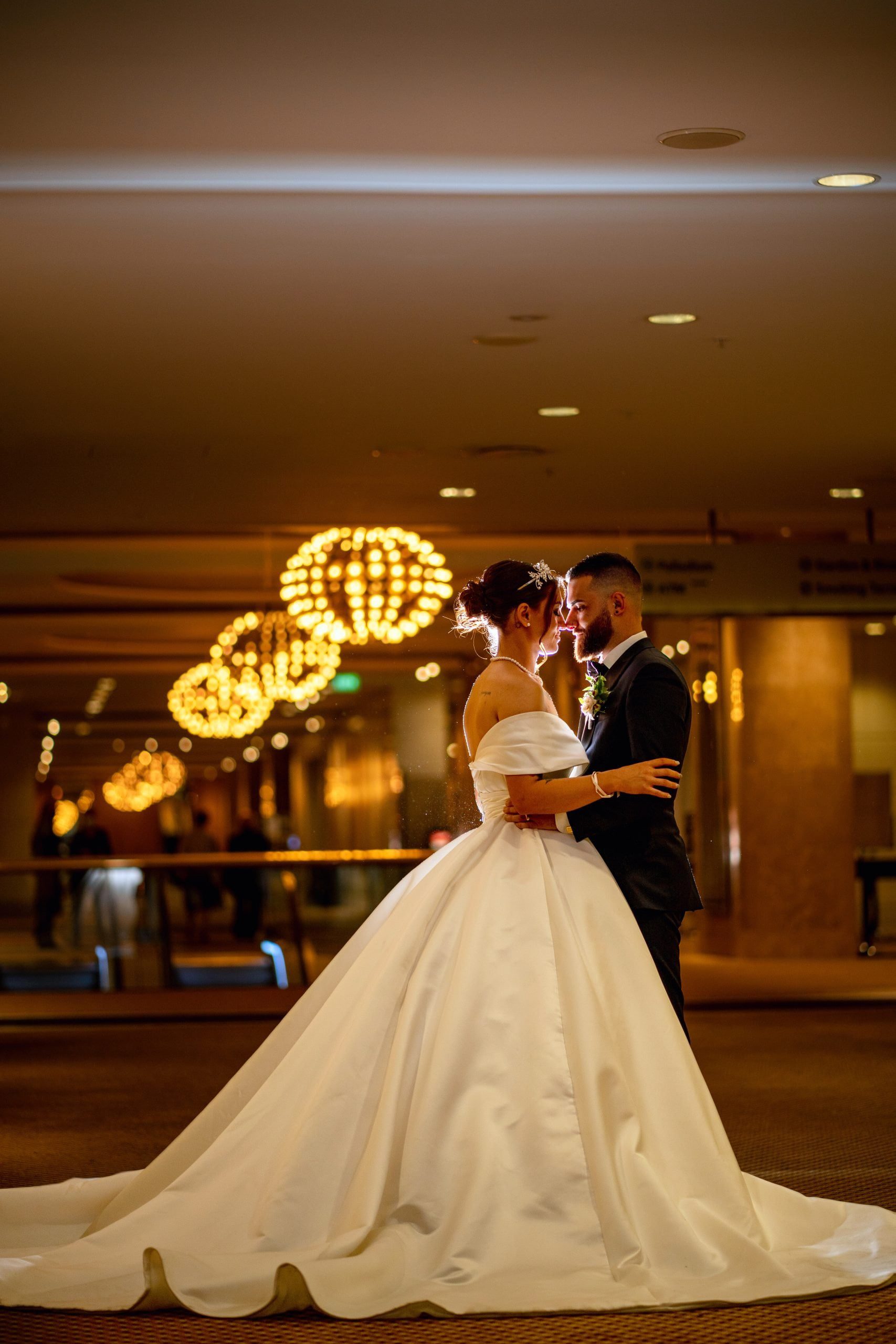
Melbourne is home to one of Australia’s largest and longest-established Chinese and Vietnamese communities. We photograph these weddings right across the city — through the eastern suburbs where the Chinese community is strongest (Box Hill, Glen Waverley, Doncaster, Mount Waverley, Balwyn), the Vietnamese communities of Richmond, Footscray, Springvale, Sunshine and St Albans, the city’s Chinatown, and the banquet venues and function centres in between. Morning rituals in a family home or hotel suite, a garden or church ceremony, an evening reception in a grand ballroom — we go wherever your day takes us, and there are no travel charges anywhere in Victoria.
At a Chinese tea ceremony the couple serves tea to their elders in order of seniority, usually beginning with the groom’s parents and grandparents and then the bride’s. The couple often kneels or bows as a sign of respect. Each elder sips the tea and gives a blessing along with a red envelope (lai see) or gold jewellery, and the ceremony formally joins the two families. It’s usually held early in the day in a family home, hotel suite or a quiet room at the venue, and runs roughly 20–45 minutes. For photography it’s intimate and fast-moving in tight, mixed light, so an experienced photographer positions in advance to capture every elder and every gesture without intruding.
They share the same heart — serving tea to elders as a mark of respect — but differ in the detail. In a Vietnamese ceremony (Đám Hỏi / Lễ Gia Tiên) the groom’s family arrives carrying mâm quả, red lacquer trays of betel and areca, tea, fruit, cakes and often a roast pig, carried by unmarried family members. Incense is lit at the ancestral altar, both families are usually honoured together, and the couple more often stands rather than kneels. The bride wears the áo dài, frequently in red and gold, with a khăn đóng headdress. Chinese ceremonies tend to be more formal in posture and centre on red envelopes and symbolic sweets.
The tea ceremony is typically one of the first events of the day. The groom collects the bride in the morning — often after gate games — and the tea ceremony follows, before any Western-style ceremony or the evening banquet. Some families hold one combined ceremony; others hold a tea ceremony at the bride’s home and a second at the groom’s. Because it happens early and indoors, the light is usually mixed and low. The early start matters for coverage: a tea ceremony at 9am and a banquet finishing near midnight makes for a long day, so it’s worth confirming your photography hours stretch across both ends.
Because an Asian wedding often spans several events — hair combing, gate games, tea ceremony, sometimes a Western ceremony, then a long evening banquet — couples usually need more coverage than a single-ceremony wedding. Many run from a morning tea ceremony through to a late reception, which can mean ten or more hours across the day, sometimes over two locations. A good approach is to map your run-sheet first and then match coverage to it. Our photography packages run to 10 hours, and we’re happy to tailor coverage to a multi-ceremony day.
For many Asian weddings, a second photographer is well worth considering. With simultaneous moments — the couple in one room and elders reacting in another during the tea ceremony, the chaos of gate games, or a grand banquet entrance and lion dance happening alongside the family’s reactions — two photographers mean two angles and nothing missed. A second shooter also helps when the day is long and spread across several locations. Whether you need one or two comes down to your run-sheet, and we’re happy to advise honestly rather than upsell.
In Melbourne, wedding photography generally ranges from around $1,500–$2,200 at the budget end, $2,500–$4,500 mid-range, and $5,000+ for premium coverage, with the city average near $3,400. An Asian wedding can sit a little higher simply because it often needs more hours, and sometimes a second photographer, to cover multiple ceremonies. Our photography starts from $1,650, and combined photography and videography — which around nine in ten of our couples choose — starts from $3,950, fully customisable to your day.
Tell us your date and venue and we’ll reply with availability and packages — usually the same day.